24-hour digital clock with CD4518 counters and CD4511 decoders
Hours, minutes and seconds on six 7-segment displays, counted from a watch crystal by CMOS chips alone, with buttons to set the minutes and the hours.
It opens in your browser without an account, read-only and ready to run.
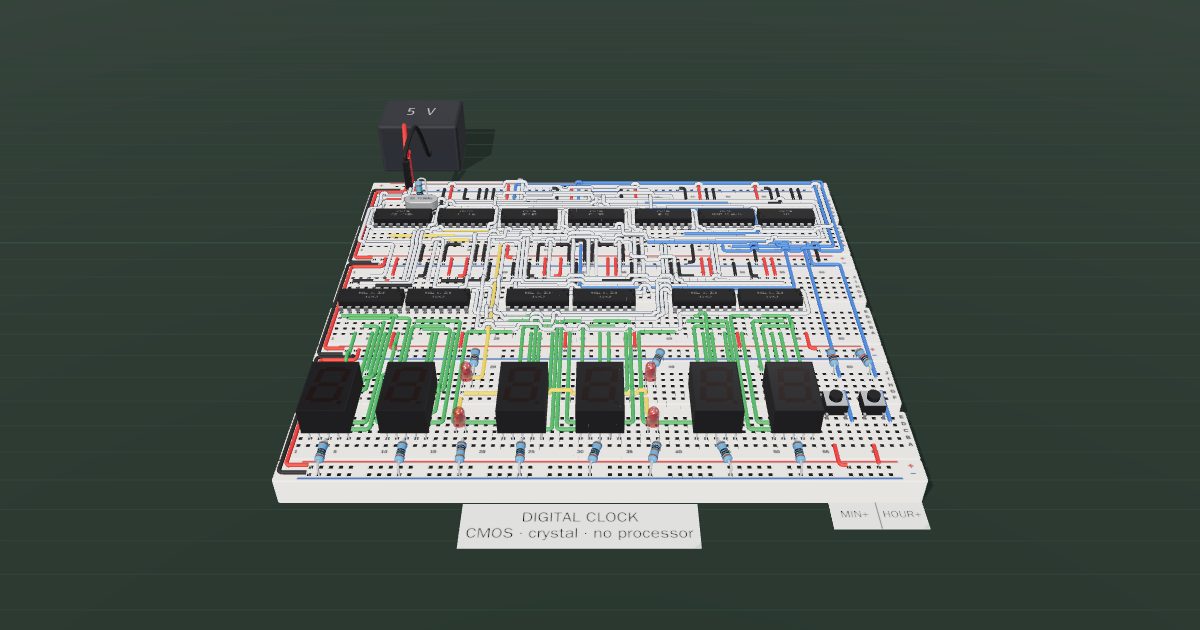
Every example opens as a schematic too, drawn in KiCad’s style and kept in step with the breadboard: a part added on one shows on the other.
How it works
A 32.768 kHz crystal on a CD4060 oscillator and divider gives 2 Hz; a CD4013 flip-flop halves it to 1 Hz.
Three CD4518 dual BCD counters count the seconds, the minutes and the hours. A CD4081’s AND gates reset them at 60, 60 and 24, and a CD4070’s XOR gates let the MIN+ and HOUR+ buttons step them.
Six CD4511 BCD to 7-segment decoders drive six common-cathode displays, each through a single resistor on its common pin.
Parts
- 1 × CD4060 14-stage counter with oscillator, a 32.768 kHz crystal and its 10 MΩ resistor
- 1 × CD4013 dual D flip-flop
- 3 × CD4518 dual BCD up counters
- 1 × CD4081 quad AND, 1 × CD4070 quad XOR
- 6 × CD4511 BCD to 7-segment decoders
- 6 × common-cathode 7-segment displays, each with one 100 Ω resistor
- 4 × red LEDs for the colons, each through 1 kΩ
- 2 × push buttons (MIN+, HOUR+), each with a 10 kΩ pull-down
- 5 V supply
Run it in BBRouter
- Open the example: it opens in the editor, no account needed.
- Click Power in the toolbar to switch it on.
- Watch the seconds count, and press MIN+ or HOUR+ to set the time: after 23 the hours go back to 00.
- Click Schematic in the toolbar to see it as a schematic, and again to go back to the breadboard.
- To change it, sign in and click Fork: the copy is yours to edit.
More example circuits
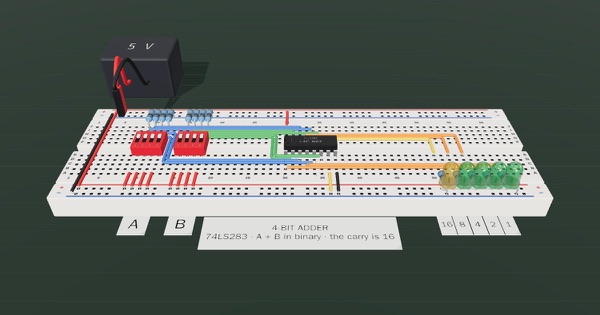
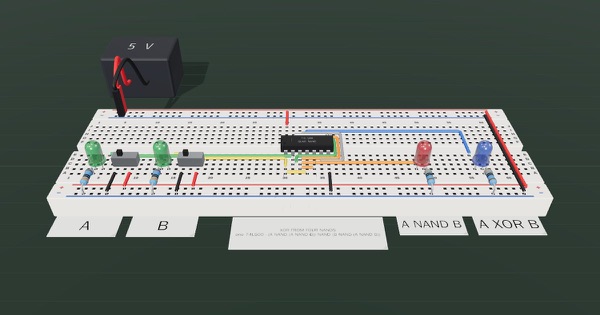
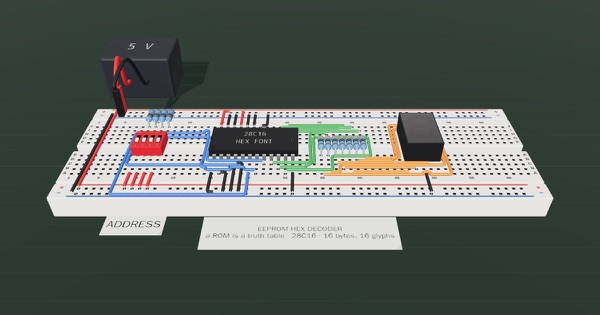
Switch it on.
Build your own circuit on breadboards in 3D, simulated as wired. Free to start.