Ben Eater’s 8-bit computer (SAP-1) on breadboards
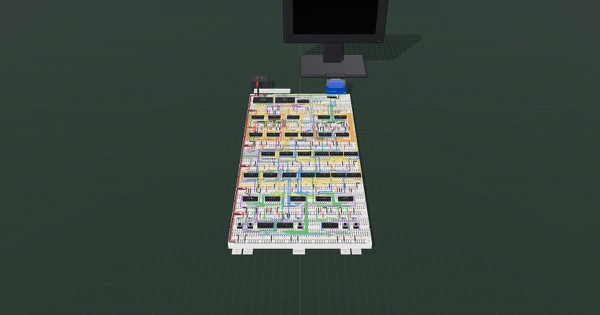
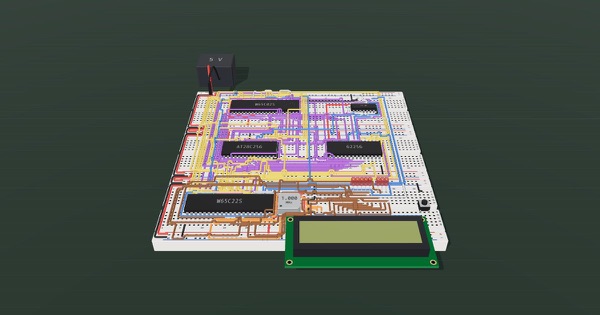
The whole computer from Ben Eater’s series, module by module on 14 breadboards, every wire laid as built and simulated as wired. His clock module and EEPROM programmer are examples of their own.
It opens in your browser without an account, read-only and ready to run.
The computer
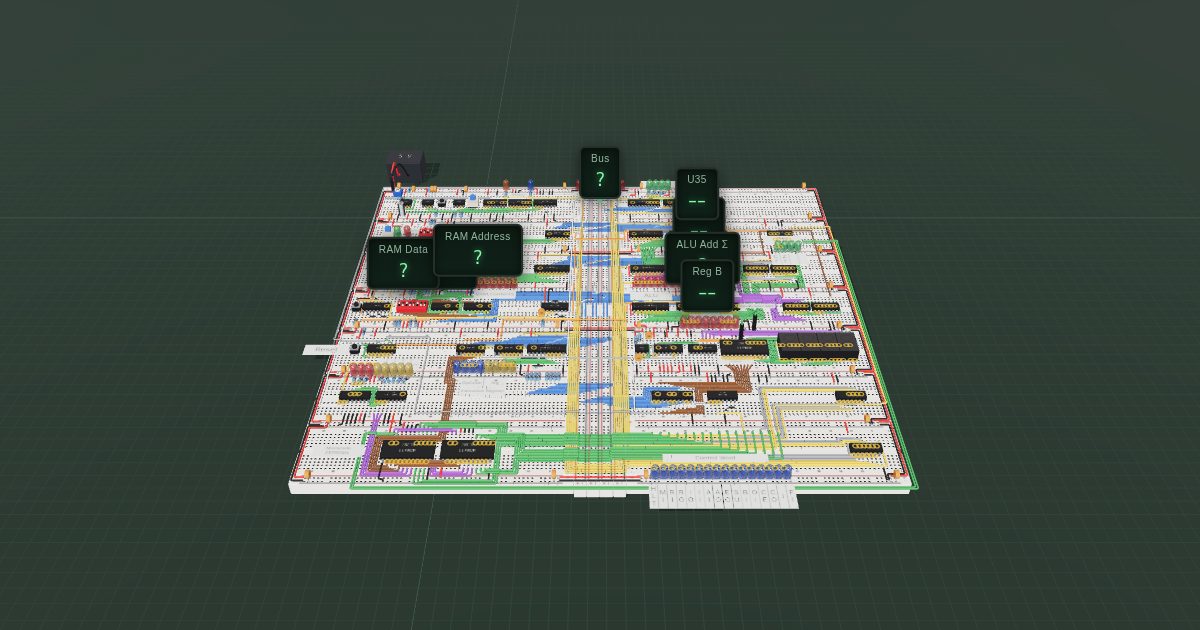
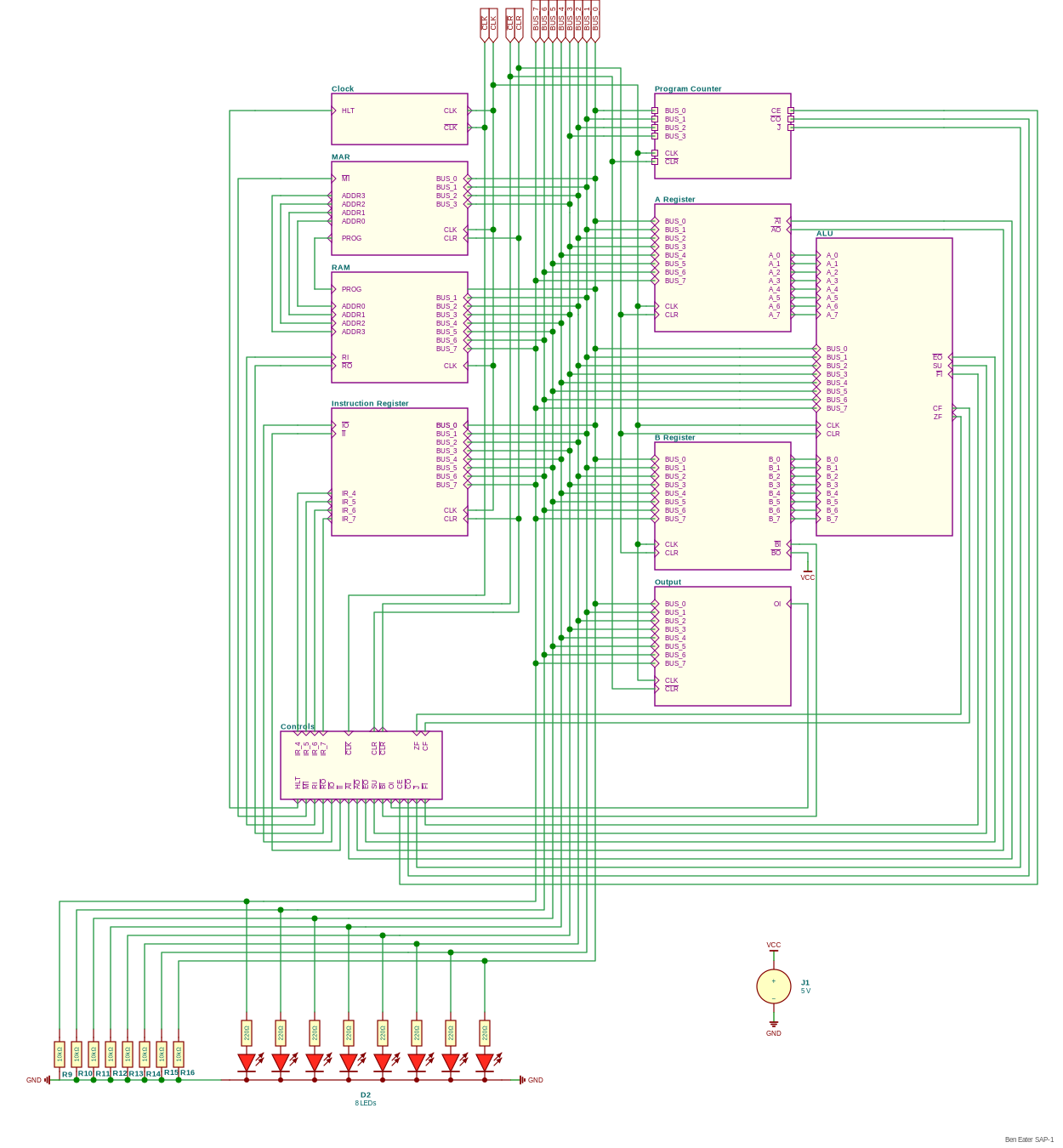
Its modules: the clock, the program counter, the memory address register, 16 bytes of RAM, the instruction register, the A and B registers, the ALU with its flags, the output display, and the control logic, whose microcode is in two 28C16 EEPROMs.
Parts
- 8 × 74LS173 4-bit registers, 6 × 74LS245 bus transceivers
- 2 × 74LS283 adders and 2 × 74LS86 XORs (the ALU)
- 2 × 74LS189 16×4 RAM, 4 × 74LS157 multiplexers
- 2 × 74LS161 counters, 1 × 74LS138 and 1 × 74LS139 decoders, 1 × 74LS273, 1 × 74LS76
- 3 × 28C16 EEPROMs (microcode and the display), 4 × 555 timers
- Gates: 2 × 74LS00, 1 × 74LS02, 5 × 74LS04, 3 × 74LS08, 1 × 74LS32
- 4 × common-cathode 7-segment displays, 88 LEDs in 15 rows, each through 220 Ω
- 3 × push buttons, 2 × switches, a 4- and an 8-position DIP switch
- Resistors: 24 × 10 kΩ, 7 × 1 kΩ, 100 kΩ, 1 MΩ, and a 1 MΩ potentiometer
- Capacitors: 25 × 100 nF, 6 × 10 nF, 1 µF
- 14 breadboards, 5 V supply
Every example opens as a schematic too, drawn in KiCad’s style and kept in step with the breadboard: a part added on one shows on the other.
The clock module
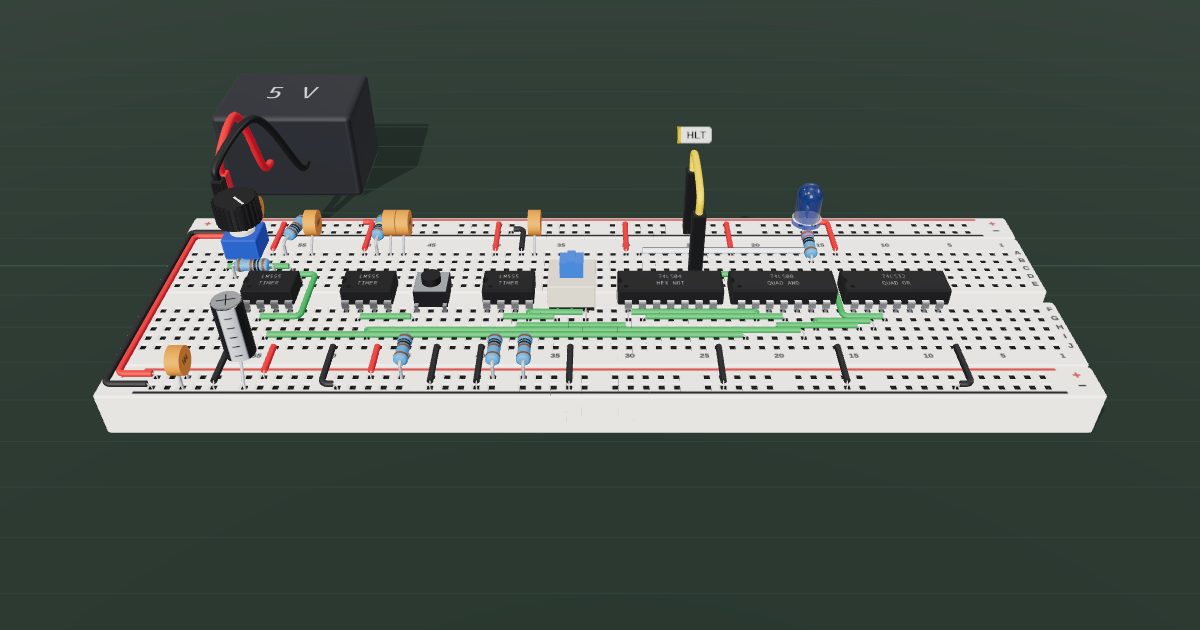
The computer’s clock on its own breadboard: three 555 timers, one running at a speed set by a 1 MΩ potentiometer and one stepping on a button press, with 74LS04, 74LS08 and 74LS32 gates choosing between them.
Parts
- 3 × 555 timers, 1 × 74LS04, 1 × 74LS08, 1 × 74LS32
- 1 × 1 MΩ potentiometer, 1 × push button, 1 × switch
- Resistors: 5 × 1 kΩ, 1 MΩ
- Capacitors: 3 × 100 nF, 3 × 10 nF, 1 µF
- 1 × blue LED through 220 Ω (the clock)
- 1 × full-size breadboard
- 5 V supply
The EEPROM programmer
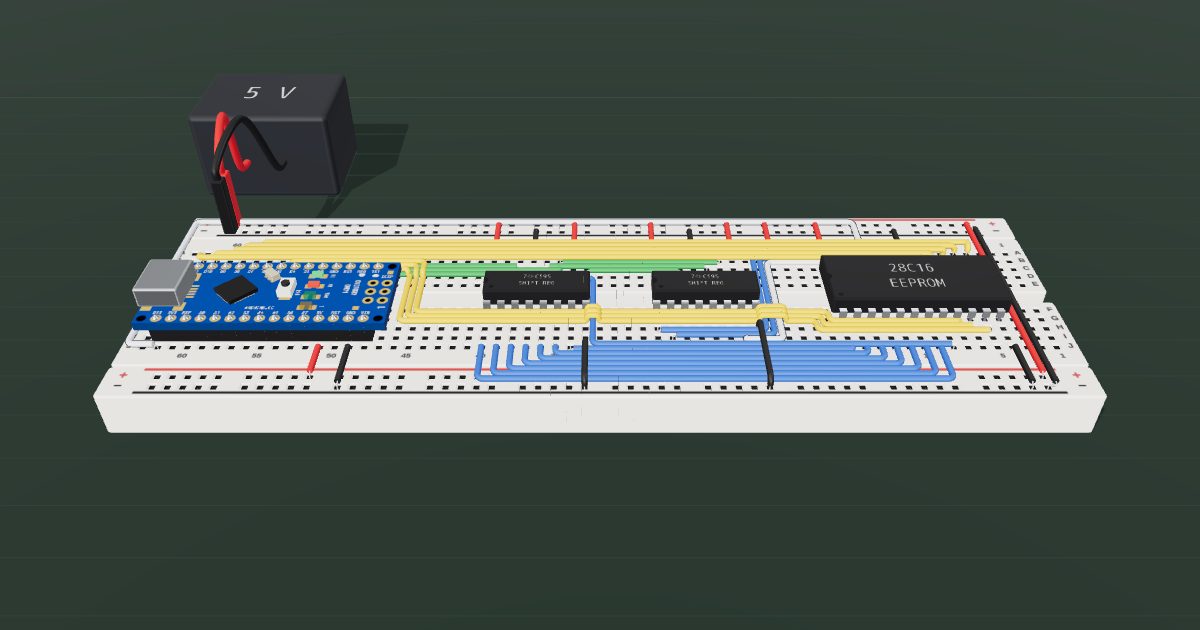
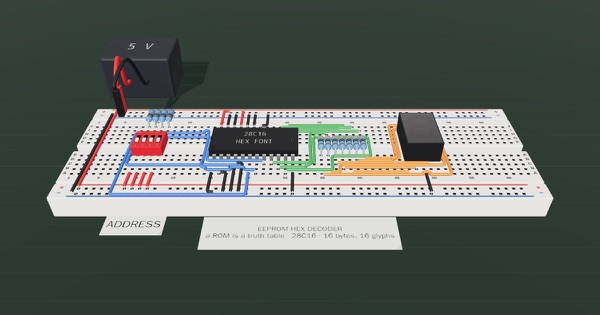
An Arduino Nano writes a 28C16: two 74HC595 shift registers set its address and output enable, D5–D12 its data and D13 its write enable. The sketch erases the chip, writes a hex digit decoder and prints the first 256 bytes on the serial monitor.
Parts
- 1 × Arduino Nano, running the example’s sketch
- 2 × 74HC595 shift registers, 1 × 28C16 EEPROM
- 1 × full-size breadboard
- 5 V supply
Run it in BBRouter
- Open the example: it opens in the editor, no account needed.
- Click Power in the toolbar to switch it on.
- Select a chip to see what it holds while the computer runs.
- Click Schematic in the toolbar to see it as a schematic, and again to go back to the breadboard.
- To change it, sign in and click Fork: the copy is yours to edit.
More example circuits
Switch it on.
Build your own circuit on breadboards in 3D, simulated as wired. Free to start.