Pong on VGA from 74-series chips, no processor
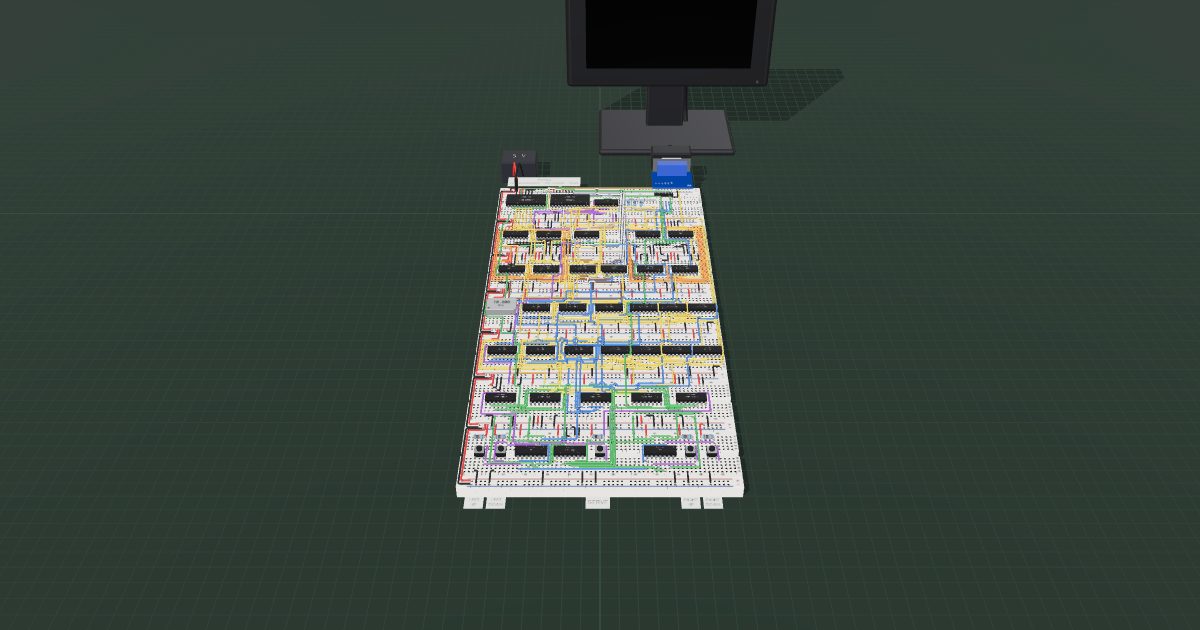
Two paddles, a ball and a net on a VGA monitor, drawn by 35 logic chips and no processor, with five buttons to play.
It opens in your browser without an account, read-only and ready to run.
Every example opens as a schematic too, drawn in KiCad’s style and kept in step with the breadboard: a part added on one shows on the other.
How it works
A 10 MHz oscillator and 74LS161 counters with 74LS30 NAND gates make the horizontal and vertical timing, as in Ben Eater’s VGA card.
74HCT193 up/down counters hold the paddles’ rows and the ball’s column and row; 74LS85 comparators find them under the beam. Two 28C16 EEPROMs draw the field and the net and tell when the ball hits a paddle, a wall or a goal.
Parts
- 6 × 74LS161 counters and 6 × 74LS30 8-input NANDs (the VGA timing)
- 6 × 74HCT193 up/down counters and 6 × 74LS85 comparators (paddles and ball)
- 2 × 28C16 EEPROMs (the picture)
- 4 × 74LS00, 2 × 74LS32, 1 × 74LS04, 1 × 74LS10, 1 × 74HCT27
- 1 × 10 MHz oscillator, 1 × VGA connector and monitor, 3 × 470 Ω on its red, green and blue lines
- 5 × push buttons, each with a 10 kΩ pull-up
- 7 breadboards, 5 V supply
Run it in BBRouter
- Open the example: it opens in the editor, no account needed.
- Click Power in the toolbar to switch it on.
- Press SERVE, then each player’s UP and DOWN buttons to move the paddles.
- Click Schematic in the toolbar to see it as a schematic, and again to go back to the breadboard.
- To change it, sign in and click Fork: the copy is yours to edit.
More example circuits
Switch it on.
Build your own circuit on breadboards in 3D, simulated as wired. Free to start.